If you are watching Clyde Hill new construction, you already know this is not a market of endless empty lots and cookie-cutter builds. Most opportunities come from scarcity, careful redevelopment, and highly tailored design decisions that have to work within a very specific local code. In this guide, you will get a clear look at the custom home trends shaping Clyde Hill today, what buyers should expect from the permitting and design landscape, and how to think about new construction versus renovation. Let’s dive in.
Why Clyde Hill new construction stands out
Clyde Hill is a small, low-density city where land is limited and redevelopment opportunities are rare. According to the city’s 2024 comprehensive plan, the city covers 632 acres, with 69.3% developed as single-family residential, and it expects only 10 net new housing units by 2044.
That scarcity shapes everything about the market. Instead of large subdivision-style development, much of the activity appears to come through teardown-and-rebuild projects on existing residential lots. City permit activity reinforces that pattern, including a November 2025 example showing both a demolition permit and a new single-family residence permit at the same property on 92nd Avenue NE.
Even with tight supply, new construction is still active. Clyde Hill’s December 2025 permit report listed 12 new single-family permits issued in 2025 totaling more than $30.7 million, with 10 more new homes pending at more than $22.2 million.
Today’s Clyde Hill home styles
Contemporary design leads
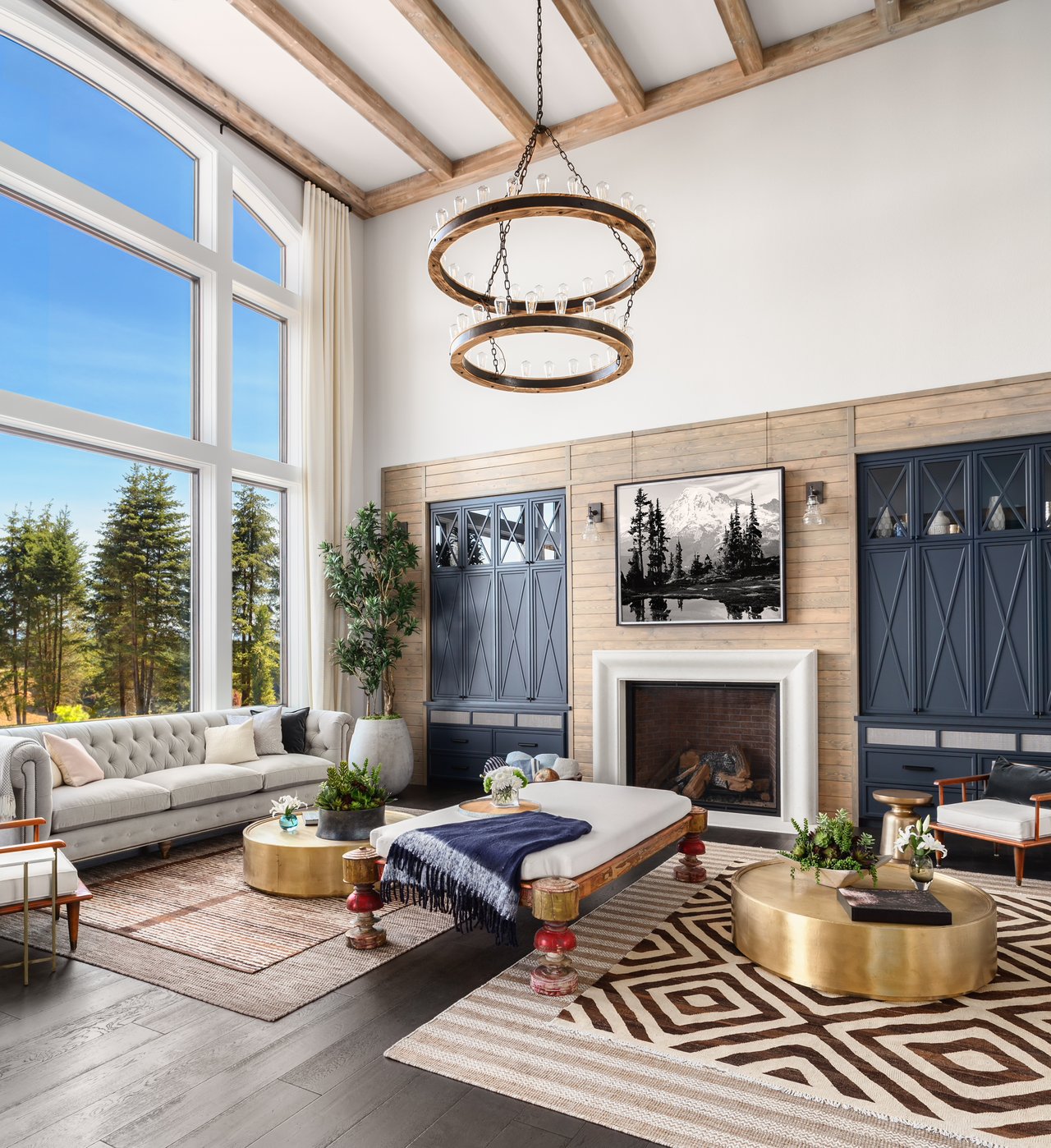
Current custom-home projects in Clyde Hill lean strongly contemporary and modern. Local examples include large custom residences with open main floors, expansive indoor-outdoor connections, pivot entry doors, metal detailing, ensuite bedroom layouts, and spaces such as offices, gyms, recreation rooms, and wine storage.
This direction fits what many luxury buyers want today. The emphasis is less about building the biggest possible house and more about creating a home that feels tailored, functional, and visually clean.
Modern farmhouse is more restrained
Modern farmhouse still shows up in Clyde Hill, but it often looks different here than it might in other markets. One local project example notes that the city’s 25-foot height cap made steep rooflines less practical, which pushed the design toward a subtler roof profile.
In practical terms, that means you are more likely to see lower-profile massing and more controlled roof forms rather than dramatic vertical silhouettes. The result still feels polished and current, but it is shaped by local rules as much as by style preferences.
Code shapes the final design
In Clyde Hill, lot constraints and zoning rules influence the design almost as much as architecture itself. If you are considering a teardown, custom build, or major remodel, these standards can have a direct effect on what is possible.
Key residential zoning limits
The city’s 2025 residential zoning rules set a fairly tight building envelope in the R-1 district. Important standards include:
- 30-foot front setback
- 35-foot rear setback
- 25-foot height limit measured from original grade
- 30% structural coverage limit
- 60% impervious coverage limit
- Minimum lot area of 20,000 square feet
- Minimum 100 feet of frontage and 100 feet of depth
Side setbacks also vary by lot size:
- Lots of 15,000 square feet or more: 15 feet on each side
- Lots between 10,000 and 15,000 square feet: 10 feet on each side
- Lots 10,000 square feet or smaller: 15 feet total, with at least 5 feet on either side
For buyers, this matters because a large price tag does not automatically mean unlimited design freedom. A home’s lot dimensions, topography, and existing improvements can all affect what a builder or architect can actually deliver.
Trees and view protections matter early
In Clyde Hill, trees and views are part of site planning from the start. The city’s view-and-sunlight rules use an arborist and hearing-examiner process to help resolve conflicts, and the comprehensive plan states that the city does not encourage tree removal simply to create new views.
That means a promising lot may still require careful planning around mature trees, neighboring outlooks, and sunlight impacts. If you are evaluating a homesite, those factors are not side issues. They are central to the design process and the long-term value of the property.
Flexibility is growing at the margins
Clyde Hill remains primarily a single-family market, but local regulations are evolving. The current code now allows single-family homes and cottage housing in the R-1 district, sets density at two dwelling units per lot, and allows up to two accessory dwelling units on lots with a single-family dwelling, subject to limits on size, height, parking, and critical areas.
The city has also extended unit lot subdivision procedures to single-family dwellings, ADUs, and other allowed middle-housing types. For many buyers pursuing luxury custom homes, this may not change the core plan. Still, it does create more flexibility for multigenerational living, guest space, or longer-term property planning.
Luxury trends buyers can expect
Performance is now baseline
Washington’s 2021 Residential Energy Code became effective statewide on March 15, 2024, and serves as both the minimum and maximum residential energy code. In other words, strong energy performance is no longer just a premium talking point in new construction. It is part of the baseline.
That shift matters in a market like Clyde Hill, where buyers often expect both refined design and everyday efficiency. A newer home may offer a more seamless fit with current standards than an older property that would need major upgrades over time.
Livability and personalization are front and center
National design trend reporting points to continued buyer demand for patios, exterior lighting, landscaping, walk-in pantries, laundry rooms, programmable thermostats, video doorbells, security features, multizone HVAC, and energy-management systems. Just as important, buyers are placing more value on personalization and authenticity than simply on square footage alone.
That lines up well with local custom-home examples in Clyde Hill. Recent projects highlight covered outdoor decks, BBQ areas, pool areas, large patios, recreation rooms, offices, gyms, premium appliances, and design choices that support both comfort and entertaining.
Local projects show the premium standard
Clyde Hill custom homes are also reflecting a strong interest in durable materials and high-performance systems. One local modern project highlights sustainable design choices such as double-wall construction, triple-pane windows, hydronic heating, aluminum siding, and concrete slab floors.
For you as a buyer, this means it is worth looking past the finish palette alone. The most compelling homes in this market often combine visual calm with thoughtful construction details that support comfort, efficiency, and longevity.
New build or renovation?
For many Clyde Hill buyers, the real decision is not just whether to buy. It is whether to pursue a custom new build on the right lot or renovate an existing home in a prime location.
When new construction makes sense
A new build can be especially compelling when the lot itself is the prize. In Clyde Hill, scarce land, view potential, code-constrained design, and the chance to create a home around current energy and livability standards can make a teardown-and-rebuild strategy attractive.
If you want a home office, better indoor-outdoor flow, updated systems, and a layout that matches how you actually live, starting fresh may offer the clearest path. This is particularly true when an older structure would require extensive work anyway.
When renovation may be the smarter move
Renovation remains a serious option in the luxury market. Houzz’s 2025 U.S. renovation study found that 54% of homeowners completed renovations in 2024, while only 4% undertook new-home construction. The same study noted that large upscale kitchens started at $150,000, which underscores how substantial high-end renovation budgets can be.
In Clyde Hill, renovation may make more sense when the site is exceptional and the existing home can be meaningfully improved without losing the location advantages that matter most. That could include preserving mature trees, maintaining established outdoor spaces, or keeping a favorable setting while modernizing the interior and systems.
What buyers should watch in Clyde Hill
If you are shopping for land, a teardown candidate, or a newer custom home, keep your focus on a few practical questions:
- How much of the lot is truly buildable within setbacks and coverage limits?
- How do tree rules or view considerations affect site planning?
- Does the existing or proposed design make smart use of the 25-foot height limit?
- Are the home’s energy systems and construction details aligned with modern expectations?
- Would renovation preserve value better than starting over?
In a market this constrained, the most successful decisions usually come from understanding the lot before falling in love with the concept. Design matters, but the site and the code often decide what is realistic.
Why local guidance matters
Clyde Hill is one of those markets where surface-level impressions can be misleading. Two properties may look similar on paper, yet the redevelopment potential, design flexibility, and long-term value can be very different once you account for setbacks, coverage limits, trees, views, and the condition of the existing structure.
If you are considering a purchase in this market, it helps to have calm, detail-oriented guidance that can connect design goals with practical next steps. That is especially true when you are weighing a custom build against a renovation, or trying to assess whether a premium lot can truly support the home you have in mind.
Whether you are exploring a teardown opportunity, comparing newer custom homes, or deciding if a renovation is the better path, working with a broker who understands design, new construction, and Eastside market nuance can help you move forward with more clarity. If you want a thoughtful, discreet conversation about Clyde Hill opportunities, connect with Andrea Korican.
FAQs
What is driving new construction trends in Clyde Hill?
- Limited land supply, redevelopment of existing lots, and strict local zoning rules are shaping most new construction activity in Clyde Hill.
What home styles are most common in Clyde Hill new construction?
- Contemporary and modern homes appear to lead current custom-home activity, while modern farmhouse designs are also present in more restrained forms due to local height limits.
What are the main zoning limits for Clyde Hill custom homes?
- Key standards include a 25-foot height limit, 30-foot front setback, 35-foot rear setback, side setback rules based on lot size, 30% structural coverage, and 60% impervious coverage.
Are accessory dwelling units allowed in Clyde Hill?
- Yes. Current code allows up to two accessory dwelling units on lots with a single-family dwelling, subject to size, height, parking, and critical-area requirements.
Is renovation a realistic alternative to new construction in Clyde Hill?
- Yes. Renovation can be a strong option when a property has an exceptional location or site characteristics that are worth preserving while upgrading the home itself.